Testing Three Characters in One Session
Three characters is the most you can compare properly in one sitting, because a fair read needs at least ten minutes each and attention falls away after about three quarters of an hour. A 45-minute budget of 3 × 12 minutes plus a 9-minute buffer gives every candidate the same conditions, which is the only way a comparison means anything.

Key takeaways
- Equal time is the whole method: 12 minutes per character, 36 in total, plus a 9-minute buffer inside a 45-minute session.
- Pick the three from measured signals, not thumbnails — 7.1K favourites from 24.3M views is a 0.029% rate worth noticing.
- Judge each card on the same three things: how the first two replies land, whether the tags describe the experience, and whether the premise survived ten minutes.
- Write one line per character before opening the next, because impressions collapse into each other without notes.
Why a fixed budget beats open browsing
Open browsing gives the first interesting card all the time and the rest none, which means you learn about one character and nothing about the alternatives. A fixed budget removes that bias: every candidate gets the same window, so differences in the experience are attributable to the characters rather than to how long you spent with them.
Twelve minutes is the useful minimum. Below that, a first-reply quirk dominates the verdict and you never see whether the character can sustain a premise. Above twenty, you are no longer comparing three candidates; you are settling into one and the other two become formalities. Forty-five minutes total also fits inside a single evening without turning a decision into a project.
Choosing the three candidates in advance
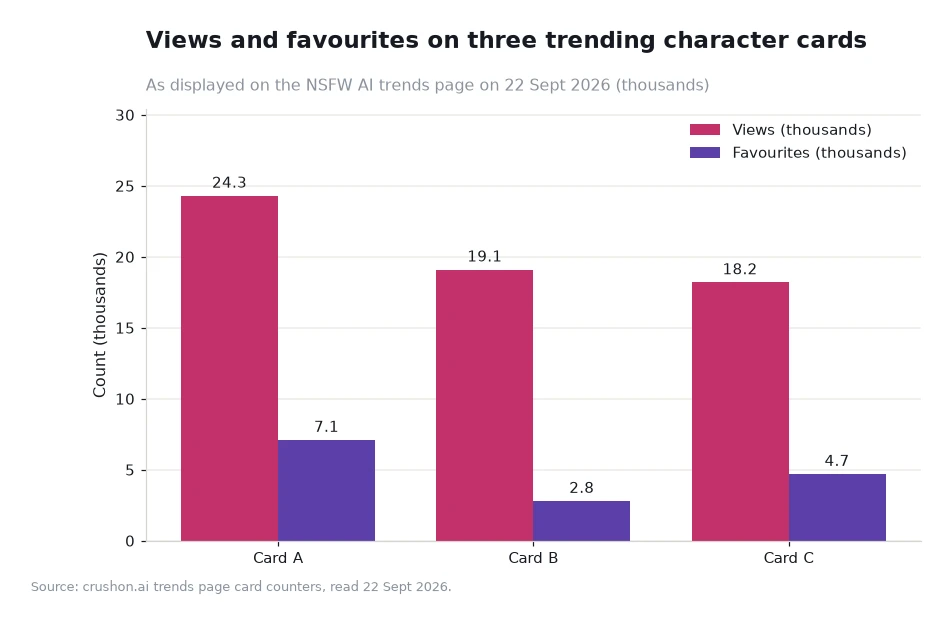
Selection should happen before the clock starts. The weekly chart is a reasonable shortlist because its counters are visible: Eri at 24.3M views and 7.1K favourites, Eva at 19.1M and 2.8K, Takara at 18.2M and 4.7K, all read on 22 Sept 2026. Dividing favourites by views gives 0.029%, 0.015% and 0.026% respectively, and a spread that wide is a useful thing to test rather than trust. Every card on a Porn Chat AI service is reachable in the same way; what differs is whether it suits the evening you have.
A good three-way set covers different tag families rather than three variations on one theme. If all three carry the same tags, the session will end with one winner and two near-clones, which is not a comparison. Pull one from the chart, one from a tag search you have not tried, and one you have already saved but rarely open — the third category is where the surprising results tend to come from.
What to measure in twelve minutes
Three observations fit comfortably in the window. The first is the opening: how the character answers your first message, and whether the second reply builds on it or resets it. The second is tag honesty, which is simply whether the experience matches the words on the card. The third is premise durability: at minute ten, is the scenario still developing, or is it repeating the opening?
Score each of the three out of three, and note that the scoring is relative. A character that scores two of three in an evening of strong candidates is not bad; it is third. The score's only job is to make the order plain before memory blurs the details into a vague sense that one of them was better.
A one-line note per card is the whole record. Write the single moment that stands out, positive or negative, and a word on whether the tags described what happened. Three such notes — six sentences in total — take under five minutes to write and settle the order of the three. Without them, the last candidate tested usually wins for no better reason than recency, which is the most common way a structured trial quietly becomes an unstructured one.
| Phase | Minutes | What it settles |
|---|---|---|
| Shortlist check | 3 × 60 seconds | Confirms the three cards and their tag rows |
| Candidate one | 12 | Opening quality and premise durability |
| Candidate two | 12 | Same three measures, under the same conditions |
| Candidate three | 12 | Same again, ideally from a different tag family |
| Buffer and notes | 9 | One written line per card, then the verdict |
Worked example: adding the minutes up
The schedule is deliberately simple arithmetic. Three candidates at 12 minutes each is 3 × 12 = 36 minutes. A three-minute shortlist check at the start takes the running total to 39. Adding a 9-minute buffer for writing one line per card and choosing a winner gives 39 + 9 = 48 — slightly over the 45-minute target, so either the shortlist check moves outside the clock or the buffer shrinks to 6 minutes, leaving 36 + 6 = 42 inside the hour comfortably.
The counters deserve the same treatment. Favourites divided by views on the three charted cards gives 7,100 ÷ 24,300,000 ≈ 0.029% for Eri, 2,800 ÷ 19,100,000 ≈ 0.015% for Eva and 4,700 ÷ 18,200,000 ≈ 0.026% for Takara. The second card has the lowest keep rate of the three despite ranking second on views, which is exactly the kind of mismatch a same-conditions trial is designed to test.
Running a porn ai chat trial that decides something
The failure mode of a trial is a verdict with no evidence behind it. Notes of one line per card prevent that: write down the single moment that stands out, positive or negative, before the next candidate opens. Three lines at the end of the session are worth more than a remembered feeling about which one was better.
Repeat the process weekly for a month and the pattern becomes visible. Characters that score well on tag honesty in week one tend to score well again; characters that felt promising but scored poorly on premise durability rarely improve with a second visit. If the shortlist runs dry, the NSFW AI trends page rebuilds every Thursday, and a tag search covers everything the 20-card window leaves out.
Frequently asked questions
Why exactly three characters?
Because twelve minutes each is the minimum for a fair read and attention rarely holds beyond about 45 minutes. Three candidates at 12 minutes leaves room for a shortlist check and a written note per card without stretching the session.
Should I judge on the first reply?
Use it as one data point out of three, not the verdict. Across a 36-minute trial the opening reply is roughly a third of the evidence at most, and plenty of characters that open weakly sustain a premise better than ones that open well.
What if two candidates score identically?
Break the tie on which one you would open again next week. The trial produces an order rather than a winner, and the cheapest tiebreaker is the card you would return to without being reminded.
Keep the schedule, drop the ceremony
Set a timer, give three cards the same twelve minutes, write one line each and score them out of three. The method is deliberately unglamorous, and its value is that it produces a decision you can explain rather than a preference you can only feel. Next week the shortlist will look different, which is the point of doing it on a schedule.
Data and sources: counters and tag labels on the Crushon trends page, and the AI porn chat page[1], read 22 Sept 2026. The 45-minute schedule and the weekly repeats are illustrative assumptions; the percentage figures are arithmetic on the published counters. Suitable only for readers who are at least 18 years old.